

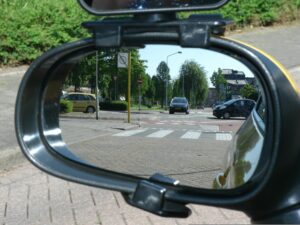
Correct mirror adjustment is an essential part of responsible driving and should never be treated as a minor vehicle preparation task. Properly positioned mirrors help drivers maintain a clear view of surrounding traffic, reduce blind spots, and make better-informed decisions when changing lanes, overtaking, reversing, or slowing down.
Every driver has a responsibility to ensure that the vehicle’s rear-view and side mirrors are correctly adjusted before starting a journey. A mirror that is poorly positioned can limit visibility and increase the possibility of missing motorcycles, pedestrians, cyclists, or other vehicles approaching from the side or rear.
Driver safety begins with awareness, preparation, and the proper use of available safety equipment. Correct mirror adjustment takes only a few moments, yet it can make a significant difference in road safety. Drivers should therefore develop the habit of checking and adjusting all mirrors before driving and throughout their journey whenever necessary.
Correct Mirror Adjustment Is a Safety Responsibility
Having mirrors fitted to a vehicle is not enough. They must be correctly positioned.
Poorly adjusted mirrors can create unnecessary blind areas and may cause the driver to misjudge the position, distance or speed of another vehicle.
Before starting a journey, drivers should ensure that:
1. The interior rear-view mirror provides a useful view of the road behind.
2. Both right and left side mirrors are correctly positioned.
3. The mirrors are clean.
4. The mirrors are not cracked or seriously damaged.
5. Objects inside the vehicle are not unnecessarily blocking the driver’s view.
6. The driver’s seat is properly adjusted before final mirror adjustment.
Drivers should also remember that changing the seat position can change the mirror view. Therefore, professional drivers who share vehicles should not simply assume that the previous driver’s mirror settings are suitable for them.
Mirror Checking Should Become a Driving Habit
One of the most effective ways to improve road safety is to make mirror observation a routine part of driving.
A responsible driver should periodically check the mirrors rather than waiting until a dangerous manoeuvre is about to occur.
Regular checks help the driver build an understanding of what is happening around the vehicle.
For example, a driver may observe:
– a motorcycle approaching from behind;
– a vehicle preparing to overtake;
– a bus entering an adjacent lane;
– a pedestrian near the vehicle;
– a vehicle following too closely;
– an emergency vehicle approaching;
– traffic becoming congested behind.
This information can influence the driver’s decisions before a dangerous situation develops.
Mirrors and Overtaking
Overtaking is one of the manoeuvres that requires particularly careful observation.
Before overtaking, a driver should understand the traffic conditions ahead, behind and alongside the vehicle.
Mirrors can help answer important questions:
– Is another vehicle already overtaking me?
– Is a vehicle approaching quickly from behind?
– Is the intended lane sufficiently clear?
– Has another road user entered the space I intend to use?
– Is my vehicle creating a risk for someone behind me?
A driver who fails to check mirrors may begin overtaking while another vehicle is already approaching from behind.
Such mistakes can lead to side-impact collisions, loss of control and potentially fatal crashes.
Mirrors and Turning
Turning, particularly on busy roads, requires awareness of vehicles, motorcycles, cyclists and pedestrians.
Before turning, drivers should check the appropriate mirrors and remain alert to road users who may be positioned alongside the vehicle.
This is particularly important for large vehicles because their turning path and blind spots can put vulnerable road users at serious risk.
A driver should never rely exclusively on the indicator when turning.
Signal and observation must work together.
The indicator tells other road users what the driver intends to do. The mirrors help the driver understand what other road users are doing.
Mirrors and Reversing
Reversing is another situation where mirrors are extremely valuable.
Before reversing, drivers should check their surroundings carefully and use available mirrors and cameras where fitted.
However, mirrors cannot always show every obstacle, child, pedestrian, motorcycle, object or person behind a vehicle.
Consequently, drivers should reverse slowly and carefully and use direct observation or assistance where necessary.
Parents, fleet operators and professional drivers should pay particular attention to reversing because vulnerable road users can easily enter areas that are difficult for drivers to see.
The Special Responsibility of Commercial Drivers
Drivers of taxis, buses, trucks, trailers, delivery vehicles and other commercial vehicles have a particularly important responsibility.
Commercial vehicles often spend many hours on public roads and interact with large numbers of road users.
A professional driver should therefore understand:
– the vehicle’s mirror system;
– its blind spots;
– the correct mirror adjustment;
– the limitations of each mirror;
– safe lane-changing procedures;
– safe overtaking procedures;
– safe turning and reversing techniques.
Fleet operators should make mirror inspection part of their vehicle safety procedures.
A vehicle should not be considered roadworthy simply because its engine starts and its tyres appear acceptable. Visibility equipment, including mirrors, and their use while driving are essential for safe driving.
In conclusion, correct mirror adjustment is a simple but important responsibility that every driver should take seriously. Clear and properly positioned mirrors provide valuable information about surrounding traffic and help drivers identify potential hazards before making critical manoeuvres.
However, mirrors should complement—not replace—the driver’s direct observation and other safe-driving practices. Drivers should remain attentive, check blind spots appropriately, use indicators, maintain safe distances, and adjust their mirrors whenever their driving position or vehicle conditions change.
Ultimately, road safety is built on responsible decisions and consistent habits. By making correct mirror adjustment part of every pre-drive routine, drivers can improve their awareness of surrounding traffic, reduce avoidable risks, and contribute to safer roads for themselves and other road users.
Thanks for reading this article.
Image credited to Pixabay.
