

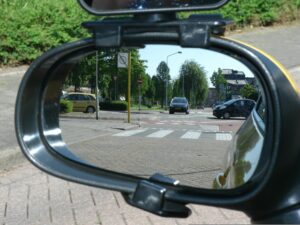
Road safety is a shared responsibility that requires every driver to remain alert, observant, and fully aware of the surrounding traffic environment. Among the many safety features fitted to modern vehicles, mirrors are often overlooked or underestimated. However, vehicle mirrors play a vital role in helping drivers observe vehicles, pedestrians, motorcycles, cyclists, and other road users that may not be directly visible through the windscreen.
The proper use of vehicle mirrors enables drivers to make safer and more informed decisions, particularly when changing lanes, overtaking, turning, reversing, parking, or slowing down. Regularly checking the rear-view and side mirrors helps a driver understand what is happening around the vehicle and identify potential dangers before taking any action. A driver who uses mirrors effectively is therefore better positioned to anticipate hazards and avoid unnecessary collisions.
However, having mirrors on a vehicle is not enough; their quality, condition, positioning, and visibility are equally important. Cracked, broken, loose, poorly adjusted, or low-quality mirrors can create blind spots and distort the driver’s view of surrounding traffic. For this reason, vehicle owners and operators should ensure that their vehicles are equipped with strong, clear, properly fitted, and reliable mirrors that provide an adequate field of vision.
The importance of quality vehicle mirrors becomes even greater on busy public roads, where drivers interact with heavy traffic, commercial vehicles, motorcycles, pedestrians, and other road users. A moment of poor visibility or failure to check a blind spot can have serious consequences. Investing in quality mirrors and maintaining them properly should therefore be regarded not merely as a vehicle-maintenance responsibility, but as an essential road-safety measure.
Ultimately, safe driving depends on the ability of drivers to see, understand, and respond appropriately to the traffic environment around them. Vehicle mirrors provide an essential second view that complements what the driver can see directly. By equipping vehicles with quality mirrors, keeping them in good condition, adjusting them correctly, and using them consistently, drivers can improve their awareness, reduce blind-spot risks, and contribute significantly to safer roads and fewer traffic accidents.

Understanding Vehicle Mirrors
Vehicle mirrors are designed to provide drivers with a wider field of vision than they can obtain by looking directly through the windscreen or windows.
The major mirrors commonly found on vehicles include: (1) Interior Rear-View Mirror, (2) Left Side and Right Side Mirrors and (3) Specialised Mirrors on Commercial and Heavy Vehicles.
The Interior Rear-View Mirror
This mirror is normally positioned inside the vehicle at the top or centre of the windscreen. Its primary purpose is to allow the driver to see traffic directly behind the vehicle.
It is particularly useful when:
– slowing down or stopping;
– preparing to overtake;
– changing lanes;
– monitoring traffic behind;
– reversing;
– assessing the distance of following vehicles.
The Left and Right Side Mirrors
Side mirrors provide information about traffic alongside and behind the vehicle. They are essential when moving from one lane to another, overtaking, turning, entering or leaving a road, and positioning the vehicle safely.
A properly adjusted side mirror should minimise unnecessary blind areas while still allowing the driver to maintain a useful view of the side and rear surroundings.
Specialised Mirrors on Commercial and Heavy Vehicles
Buses, trucks, trailers and other large vehicles may have additional mirrors designed to improve visibility around the vehicle. Because large vehicles have significant blind spots, these mirrors are particularly important.
Drivers of commercial vehicles have an increased responsibility to understand their vehicle’s blind spots and use all available mirrors correctly.
Why Vehicle Mirrors Are So Important
Mirrors Extend the Driver’s Vision
A driver cannot see everything around a vehicle simply by looking through the windscreen. Parts of the road environment may be hidden by the vehicle’s body, pillars, passengers, cargo, or the driver’s own field of vision.
Mirrors help extend the driver’s awareness beyond the immediate forward view.
This creates a more complete picture of surrounding traffic and helps the driver make better decisions.
Mirrors Help Detect Vehicles Approaching from Behind
A vehicle may be approaching rapidly from behind while the driver is concentrating on the road ahead.
Regular mirror checks can alert the driver to the presence of such vehicles before the driver changes speed, changes lanes, turns or makes another manoeuvre.
Without this information, a driver may unintentionally move into the path of another road user.
Mirrors Help Prevent Unsafe Lane Changes
Changing lanes without checking mirrors is extremely dangerous.
A driver may activate the indicator and assume that it is safe to move. However, signalling does not guarantee that the lane is clear.
The proper process should involve:
Mirror → Signal → Check surroundings/blind spot → Manoeuvre when safe.
The indicator communicates the driver’s intention; it does not give the driver permission to move into another lane.
The Relationship Between Mirrors and Blind Spots
One of the greatest dangers associated with vehicle mirrors is the blind spot.
A blind spot is an area around a vehicle that the driver cannot see directly through the normal mirrors or windows.
Blind spots vary according to vehicle design. They can be especially large in buses, trucks, articulated vehicles and other large vehicles.
This is why drivers should never assume that everything outside the mirror’s visible area is automatically clear.
Before making a manoeuvre, drivers should use an appropriate combination of:
– interior mirror checks;
– side mirror checks;
– direct observation where appropriate;
– indicators;
– awareness of surrounding traffic;
– caution and appropriate speed.
The principle is simple:
Mirrors reduce blind spots, but they do not eliminate the need for observation.
In conclusion, vehicle mirrors are not merely auto accessories; they are essential safety tools that help drivers understand what is happening around their vehicles. Proper and frequent use of the rear-view and side mirrors provides better awareness of approaching vehicles, pedestrians, cyclists, and other road users, reducing blind spots and helping drivers make safer decisions.
Every vehicle should therefore be equipped with good-quality, properly adjusted, clean, and functional mirrors. Drivers should make it a habit to check their mirrors regularly, especially before changing lanes, turning, overtaking, slowing down, or stopping. A few seconds spent checking the mirrors can prevent dangerous situations and potentially save lives.
Road safety is a shared responsibility, and responsible driving begins with paying attention to the details that protect everyone. Use your mirrors, maintain your mirrors, and never underestimate their importance. Good mirrors and good mirror habits can make the difference between a safe journey and a tragic accident. Drive carefully, stay alert, and help make our roads safer for everyone.
Thanks for reading.
Images credited to Pixabay by dbderuiter and Bertsz
